Altair (Alpha Aquilae) is the brightest star in the constellation Aquila (the Eagle) and one of our nearest visible neighbours, lying only 16.73 light-years away. Shining at magnitude 0.76, it is the 12th brightest star in the night sky.
Altair is one of the fastest-spinning first-magnitude stars. Rapid rotation has distorted the young star into an egg-like shape, with a bulging equator and flattened poles. The flattened shape makes Altair a striking example of how stellar rotation can alter a star’s physical appearance and properties.
Together with Vega and Deneb, Altair forms the Summer Triangle, an asterism that dominates the sky overhead during the northern hemisphere’s summer and early autumn. Closer to home, Alpha Aquilae forms the Shaft of Aquila with the two stars flanking it, Tarazed and Alshain (Gamma and Beta Aquilae).
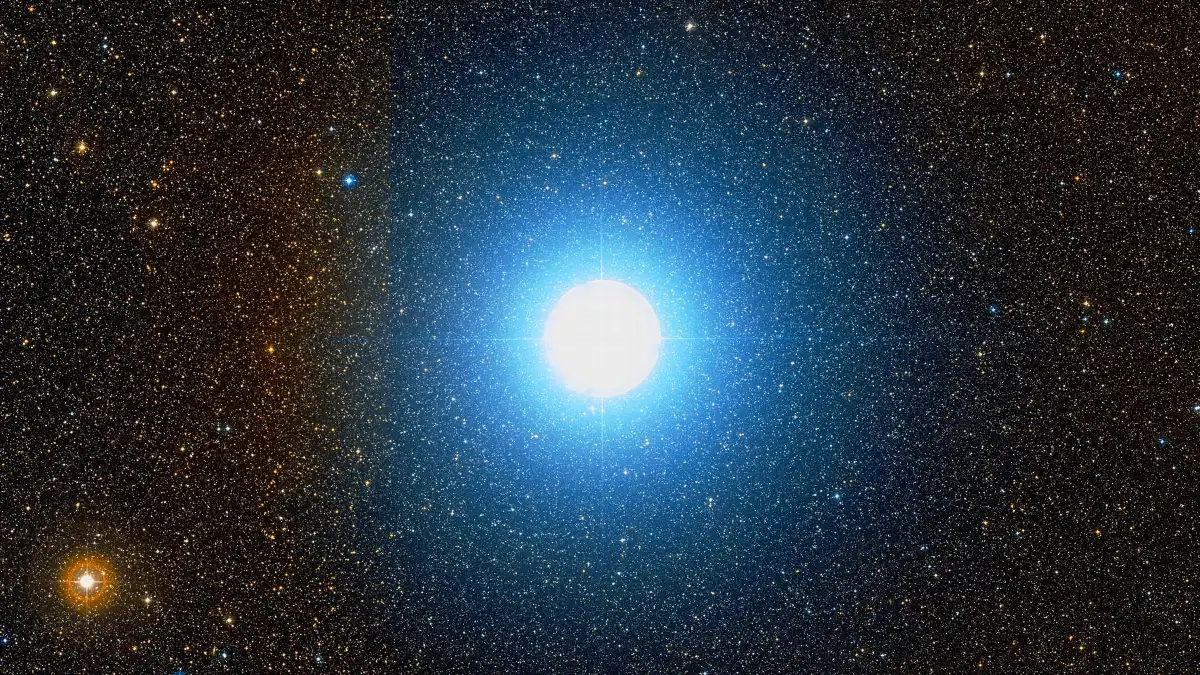
Altair, image credit: Wikisky, ESO/Digitized Sky Survey 2 (CC BY 4.0)
A star at the beginning of its main sequence life
Altair is a main sequence star of spectral class A7Vn, hotter, larger, and more luminous than the Sun. With an estimated age of only about 88 million years – a small fraction of the Sun’s age – it is believed to lie close to the zero-age main sequence, the point at which a young star first begins fusing hydrogen into helium in its core.
With 1.86 times the Sun’s mass, Altair will live a much shorter life than our parent star because it burns through its fuel much faster. It will, however, take the same basic evolutionary steps, from the main sequence to a red giant, and ultimately to a white dwarf surrounded by a bright planetary nebula.
A-type stars typically live for around a billion years, but a star’s exact lifespan depends on its initial mass. Altair is the fourth brightest A-type star in the sky, after Sirius, Canopus, and Vega.
The star was classified as a Delta Scuti variable in 2005. It exhibits variations in luminosity over periods that range from 0.8 to 1.5 hours.
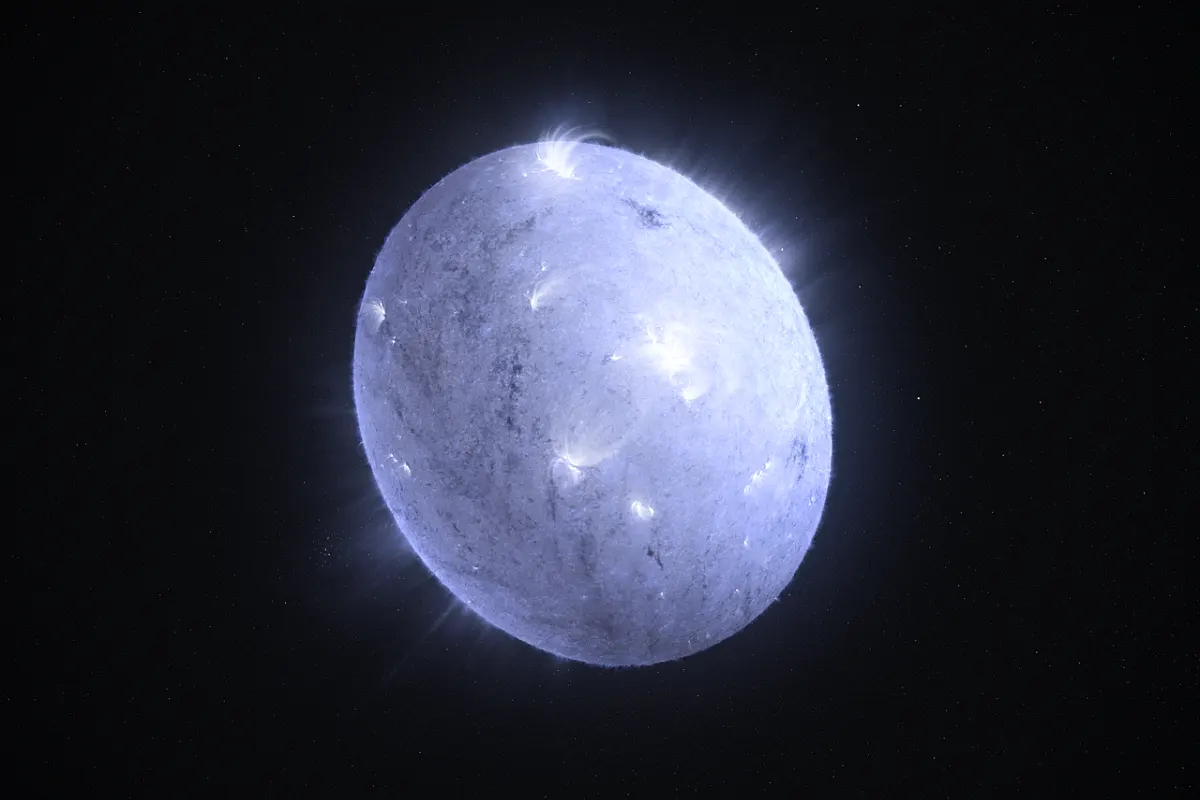
Altair is a nearby main sequence rapidly rotating star which is spinning so fast that it is flattened along its poles. Another interesting thing about rapid rotators is the gradual darkening around the equator. These characteristics were predicted before the technology to observe them was created, but now both flattening and darkening have been observed using astronomical interferometers here on Earth. This illustration is based on data collected by the CHARA array in 2006 for Monnier et al. Image credit: Judy Schmidt (CC BY 2.0)
Flattened at the poles: What Altair’s shape reveals
Altair is an exceptionally fast spinner. A 2020 study found a true equatorial velocity of around 314 km/s, giving Altair a rotation period of only 7.77 hours (7 h 46 m). In comparison, the Sun takes about 25 days to complete a spin.
Because Altair has retained much of its primordial spin, its shape has been flattened to an oblate spheroid, with an equatorial radius more than 20 percent larger than its polar radius.
The star’s poles are closer to the centre of mass and therefore much hotter and brighter than the equatorial region. This effect is called gravity darkening and can be seen in all fast-spinning stars. The brightest examples include Vega in Lyra, Achernar in Eridanus, Hadar in Centaurus, Spica in Virgo, and Regulus in Leo.
Altair spins at a significant fraction of its estimated breakup velocity of roughly 400 km/s. Astronomers believe that the fast rotation drives rotational mixing, which brings fresh hydrogen to the star’s core and extends its main sequence lifetime.
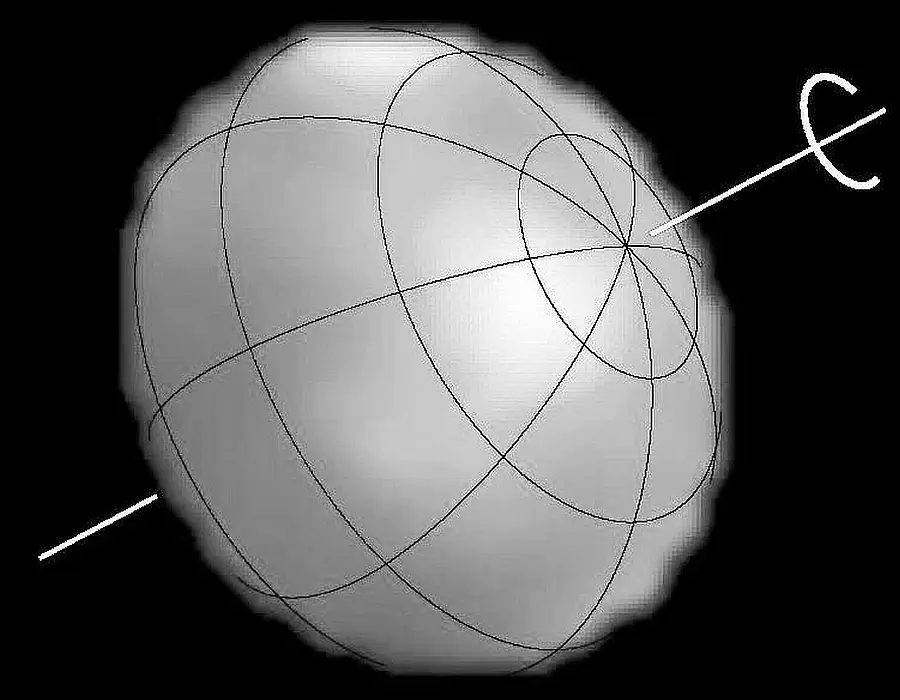
Altair captured by the MIRC imager on the CHARA Array on Mt. Wilson, image credit: Ming Zhao, John Monnier (PD)
Altair in the constellation figure of Aquila
In the constellation figure of the Eagle, Altair and the fainter Alshain are part of the bird’s neck, while Tarazed marks its shoulder.
In modern interpretations, Guqi (Delta Aquilae) appears in the Eagle’s chest, Okab (Zeta Aquilae) and Antinous (Theta Aquilae) mark the wings, and Lambda Aquilae the tail. However, traditional depictions place Okab at the tail and Guqi at the wing, while Theta Aquilae once belonged to the obsolete constellation Antinous.
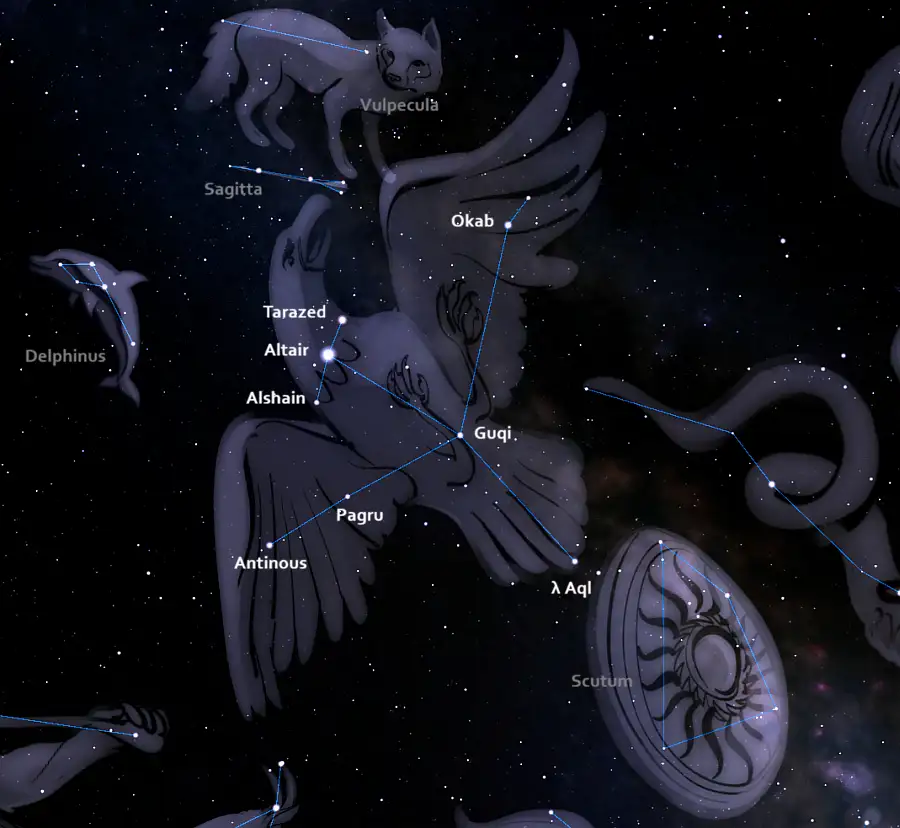
Altair in the constellation figure of the Eagle, image: Stellarium (annotated for this article)
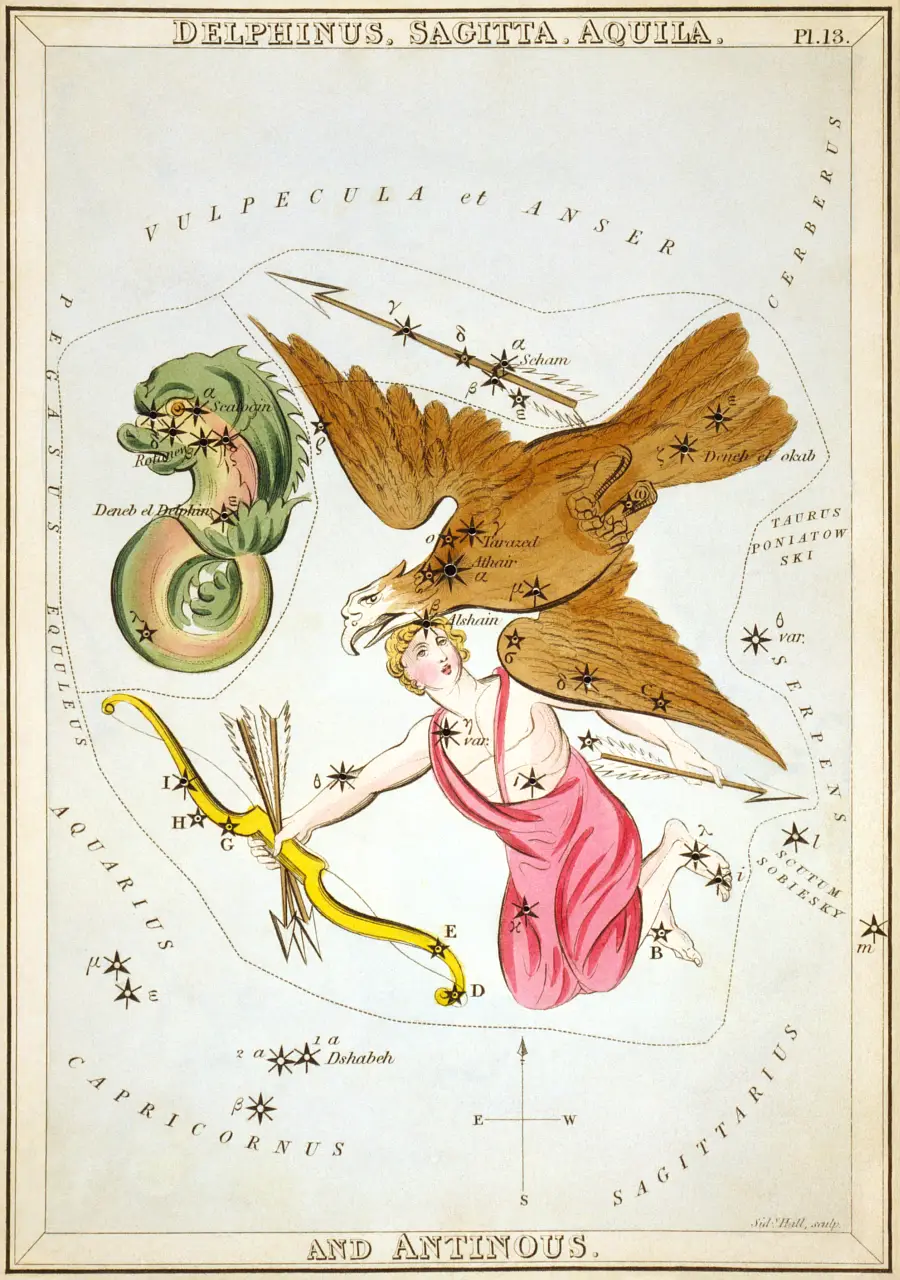
“Delphinus, Sagitta, Aquila, and Antinous”, plate 13 in Urania’s Mirror, a set of celestial cards accompanied by A familiar treatise on astronomy… by Jehoshaphat Aspin. London. (PD)
Shaft of Aquila
Altair forms an asterism known as the Shaft of Aquila, or the Family of Aquila, together with Alshain and Tarazed (Beta and Gamma Aquilae). The three stars form an almost straight line spanning about 4 degrees.
Even though they appear in the same line of sight, they are not physically related. Tarazed and Alshain are more evolved stars located at greater distances. Alshain is a yellow subgiant star close to the Sun in age, lying 44.36 light-years away, and Tarazed is an orange bright giant 395 light-years away.
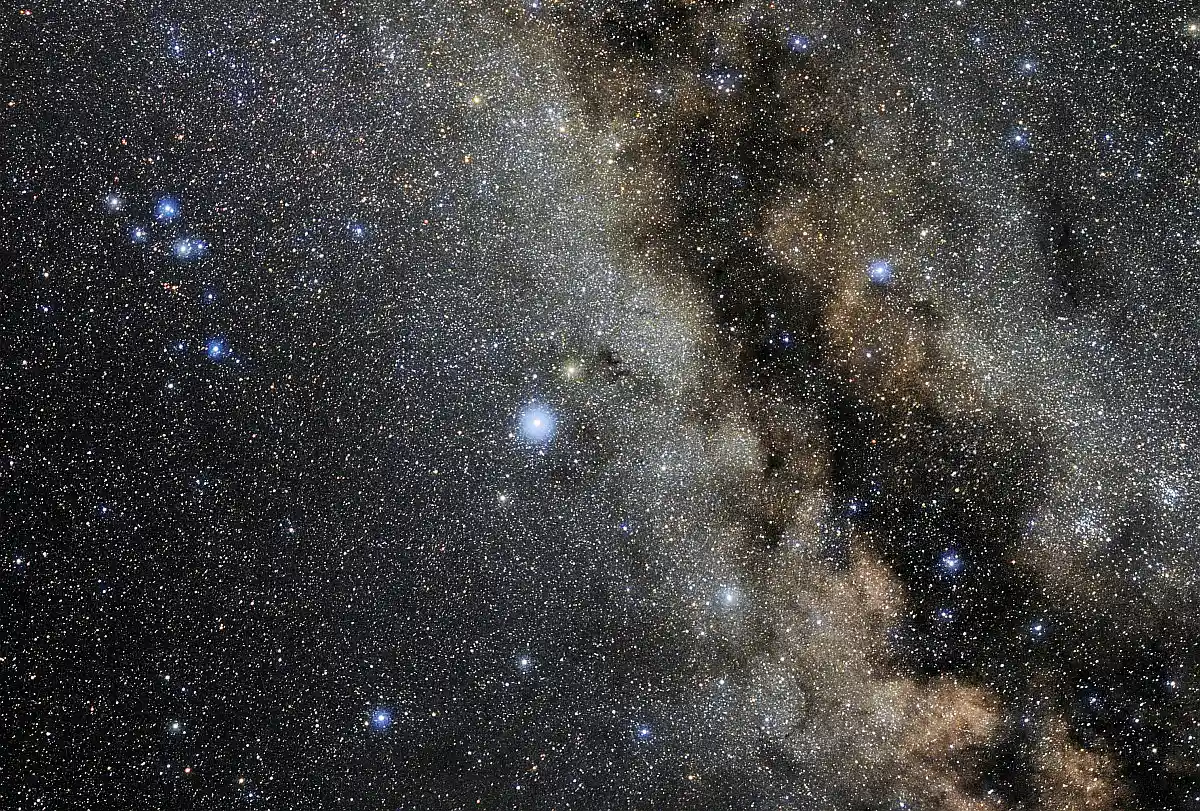
The Shaft of Aquila, cropped from an image of the constellation Aquila produced by NOIRLab in collaboration with Eckhard Slawik, credit: E. Slawik/NOIRLab/NSF/AURA/M. Zamani (CC BY 4.0)
Summer Triangle: Altair, Vega and Deneb
Altair is one of the three bright vertices of the Summer Triangle, one of the most recognizable patterns in the night sky. It forms the asterism with Vega and Deneb, the brightest stars in the constellations Lyra and Cygnus. The brighter Vega is part of the faint but distinctive constellation figure of the Lyre, and the fainter Deneb marks the tail of the celestial Swan.
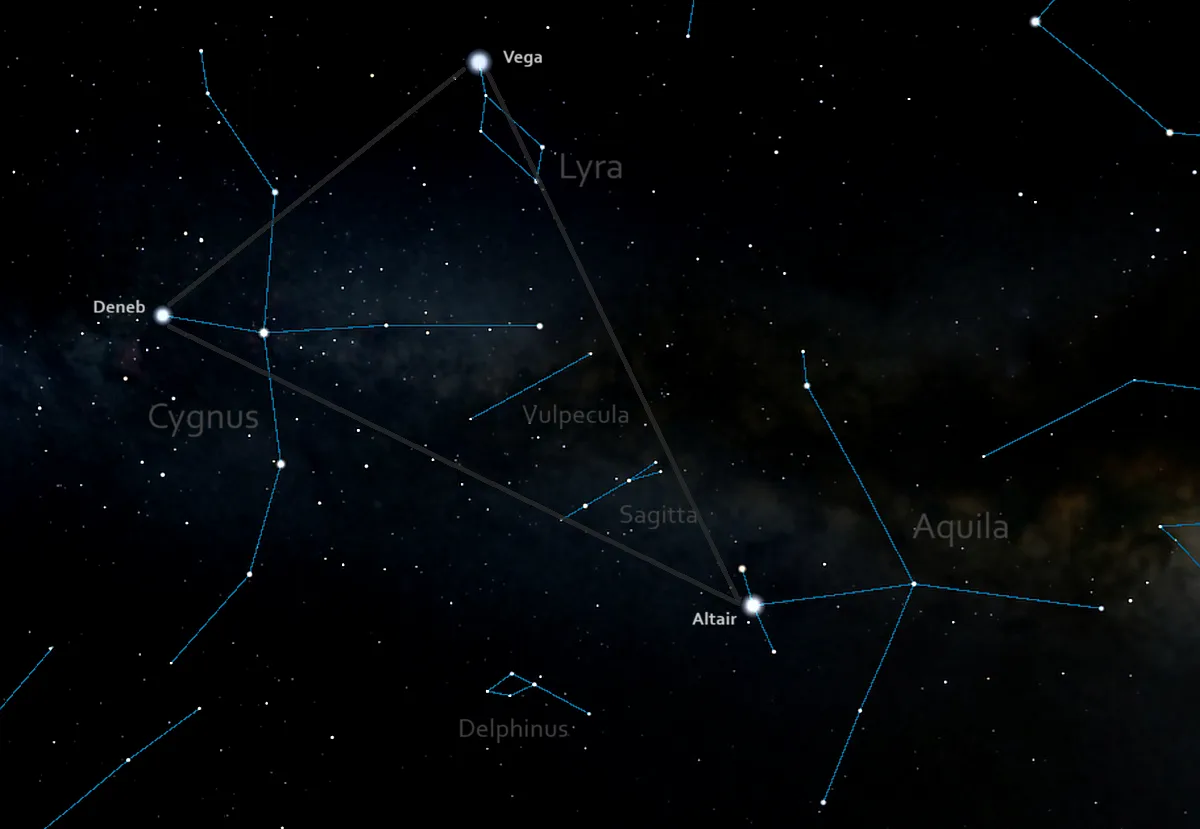
Summer Triangle – Altair Vega Deneb, image: Stellarium (annotated for this article)
Where to find Altair in the night sky
Altair and the bird-like figure of Aquila stand out next to the rich star fields of the Milky Way around the celestial equator, appearing high overhead during the northern hemisphere summer. Altair is easy to identify as the southernmost star of the elongated Summer Triangle and the only first-magnitude star with two relatively bright neighbours on either side.
Aquila lies in the region between the Northern Cross in Cygnus and the Teapot in Sagittarius. It appears to fly opposite the brighter Swan, with their beaks facing one another. The small but recognizable constellations Delphinus (the Dolphin) and Sagitta (the Arrow) appear in the region between the Eagle’s head and the Swan’s outstretched wing.
Located only 9 degrees north of the celestial equator, Altair can be seen from virtually any inhabited location on Earth. The best time of the year to see it is during the northern hemisphere summer.
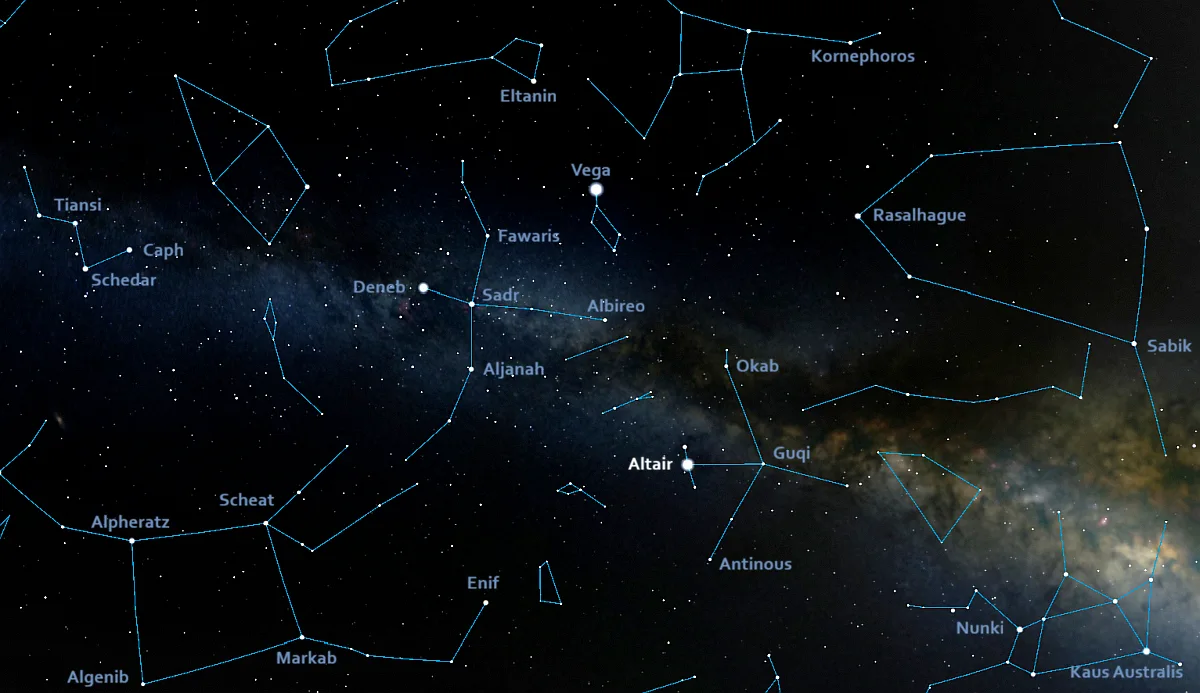
Location of Altair in the constellation Aquila, image: Stellarium (annotated)
The Flying Eagle: Where Altair gets its name
The name Altair comes from the Arabic phrase an-nasr aṭ-ṭā’ir, meaning “the flying eagle.” The association with the eagle probably dates back to the ancient Sumerians and Babylonians, who knew Altair as “the eagle star.”
Arab astronomers knew the star as part of the asterism it formed by Beta and Gamma Aquilae, called Al Nesr Al Tair, a name that was later translated into Latin as Vultur Volans, the Flying Vulture.
Altair in mythology and culture
Like many bright stars, Altair has played a prominent role in cultures across the globe throughout history. Its place in the constellation Aquila has linked it to the mythology of the Eagle since ancient times, while its pairing with Vega gives it a central role in one of East Asia’s best-known celestial myths.
The Eagle of Zeus in Greek mythology
In Greek mythology, the constellation Aquila represents the eagle that carried Zeus’ thunderbolts. In one myth, the eagle kidnapped Ganymede, a beautiful Trojan boy, at Zeus’ request and took him to Olympus to serve as the cupbearer to the gods. Ganymede is represented by the constellation Aquarius.
Altair and Vega: A star-crossed love story
In a Chinese folktale, the stars Altair and Vega represent the Cowherd and the Weaver Girl, star-crossed lovers who can meet only once a year, when a flock of magpies forms a bridge across the Silver River (the Milky Way). Their annual reunion is celebrated at the Qixi Festival on the seventh day of the seventh lunar month of the Chinese calendar, as well as at the Tanabata festival in Japan and the Chilseok festival in Korea.
The tale dates back more than 2,600 years. Zhinü was a fairy who descended to Earth, became an ordinary woman, and married Niulang, the cowherd. When the Emperor of Heaven (the Jade Emperor) learned of this, he sent minions to bring Zhinü back to heaven. Niulang chased after them, but the Queen Mother of the West created the river in the sky to separate them.
Moved by their plight, the magpies decided to form a bridge across the river so that the lovers could meet once a year. In some versions, the bright Deneb represents the magpie bridge, while Tarazed and Alshain mark Zhinü and Niulang’s two children.
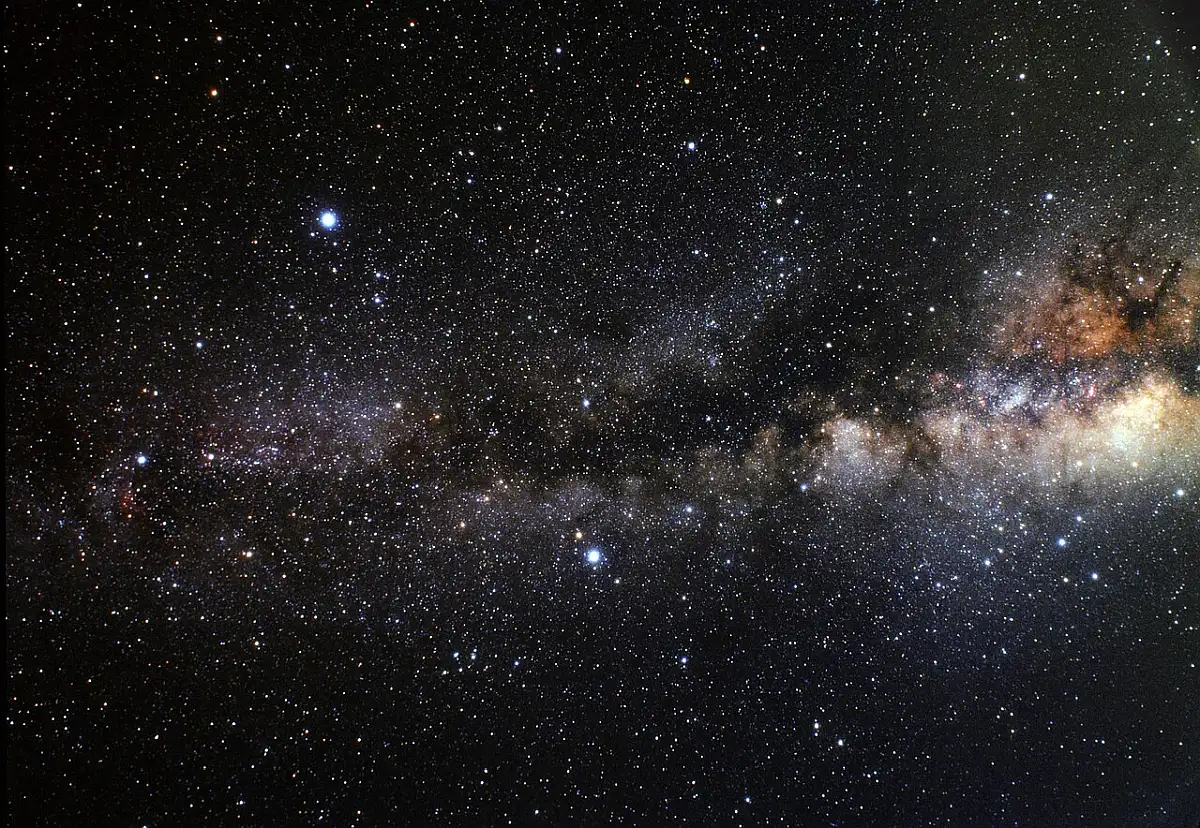
The stars of the Summer Triangle: Deneb (left), Altair (below centre), and Vega (upper left), image credit: NASA, ESA, A. Fujii (PD)
Altair in science fiction
As one of the brightest nearby stars, Altair has also become a fixture in the modern imagination as well, especially in science fiction.
Altair IV, a fictional planet orbiting the star, provided the setting for the 1956 film Forbidden Planet, one of the most influential science fiction films of its era.
The Altair system also recurs in the Star Trek universe, appearing in Star Trek II: The Wrath of Khan and in episodes across three different series: “Amok Time” in The Original Series, “Encounter at Farpoint” in The Next Generation, and “Prophet Motive” in Deep Space Nine.
Altair remains one of the most culturally recognizable stars in the night sky, referenced in mythology and science fiction alike. Marking a corner of the Summer Triangle, it is one of the easiest stars to spot on a clear summer or early autumn night.
Alpha Aquilae: Quick facts
| Constellation | Aquila |
| Right ascension | 19h 50m 46.99855s |
| Declination | +08° 52′ 05.9563″ |
| Spectral class | A7Vn |
| Apparent magnitude | 0.76 |
| Absolute magnitude | 2.22 |
| Distance | 16.73 ± 0.05 light-years (5.13 ± 0.01 parsecs) |
| Mass | 1.86 ± 0.03 M☉ |
| Luminosity | 10.6 L☉ |
| Radius | 2.008 ± 0.006 R☉ (equatorial); 1.565 ± 0.014 R☉ (polar) |
| Temperature | 6,780 K (equatorial); 8,621 K (polar) |
| Age | 88 ± 10 Myr |
| Designations | Altair, α Aquilae, 53 Aquilae, BD+08°4236, FK5 745, GCTP 4665.00, GJ 768, HD 187642, HIP 97649, HR 7557, LFT 1499, LHS 3490, LTT 15795, NLTT 48314, SAO 125122, WDS 19508+0852A |